Top Picks: Best Jeep Wrangler JLU Seat Covers

Bartact Tactical MOLLE Seat Covers — Jeep Wrangler JLU 2018–2026
Bartact's JLU seat covers are the benchmark: mil-spec 1000D Cordura nylon, non-SRS airbag certified for every JLU trim including Sport, Sahara, Rubicon, Willys, High Altitude, and 4xe (Mojave and 392 require dedicated SKUs due to their unique sport seat profiles — do not order the standard JLU pattern for those trims). The rear covers are engineered specifically for the JLU's 60/40 split fold-and-tumble rear bench, with break points sewn into the separator panel. Genuine MOLLE/PALS webbing across the seatback organizes trail gear — first aid, recovery tools, hydration. Bartact manufactures every unit by hand in the United States and stands behind their product with a direct manufacturer warranty — something no Amazon brand can match. If you run a 4-door Unlimited on trail or daily, this is the cover to own.
View Bartact JLU Seat Covers →
Smittybilt GEN2 Neoprene Seat Covers — JLU 4-Door 2018–2026
Smittybilt's second-generation neoprene covers use a thicker neoprene panel over their original design, delivering genuine water resistance without feeling clammy. The GEN2 full set covers the JLU's front buckets and the full 60/40 split rear bench — ordered as a matched set for a cohesive cabin look. Neoprene construction makes spilled coffee, mud, and trail water completely irrelevant: wipe and go. Fit is custom-cut for the JLU 4-door geometry, so installation is clean without bunching at the seat base. Compatible with factory heated seats on Sahara and Rubicon — heat passes through neoprene at reduced efficiency, so if your climate leans on heated seats heavily, consider fabric instead. Airbag-compatible seaming throughout. Best neoprene full set for the JLU at mid-tier pricing.
View on Amazon → See current price →
Aierxuan Diamond Stitch Leatherette Full Set — JLU 4-Door 2018–2026
For JLU owners who want a cleaner, more finished cabin look than tactical fabric provides, Aierxuan's diamond-quilted leatherette delivers a noticeable interior upgrade at a fraction of the cost of aftermarket leather seats. The quilted panel pattern gives the JLU cabin a sport-luxury aesthetic that fits Sahara and High Altitude trim styling particularly well. Custom-fit cut means no universal-cover bunching at the console or seatback corners. Full-set coverage includes the front buckets and the 60/40 split rear bench. The PU leatherette wipes clean easily — coffee, trail mud, and fast-food run consequences disappear with a damp cloth. Airbag-compatible seaming throughout. Caveat: open-top JLU owners who leave the doors off in summer will accelerate UV aging on leatherette — park in shade or choose Cordura for hard-top-off use.
View on Amazon → See current price →
GIANT PANDA Neoprene Full Set — JL/JLU 4-Door 2018–2026
GIANT PANDA's neoprene covers deliver strong waterproof performance at a lower price than Smittybilt GEN2, making them a smart choice for second vehicles, work Jeeps, or owners who want the material benefits of neoprene without the GEN2 price point. The JLU-specific full-set listing covers front buckets and the 60/40 rear split bench. Neoprene construction handles water, mud, and pet hair easily. Airbag-compatible seam routing on the front covers. Fit quality is solid for the price — expect minor adjustment during installation at the seatback corners, which is standard for this segment. Compatible with heated seats at reduced efficiency. Good choice for high-use working JLUs where premium aesthetics are less important than functional water resistance.
View on Amazon → See current price →
Huidasource Faux Leather Front Covers — JL/JLU 2018–2026
Huidasource's front-seat PU leather cover set targets JLU owners who want a quick interior refresh on the driver and passenger seats without committing to a full rear-bench set. The front pair includes a console cover, giving the whole center stack a cohesive leatherette finish. Construction is JL/JLU-specific with airbag-compatible seam routing on both front seats. Installation is straightforward and reversible. The PU leather surface wipes clean quickly and resists minor moisture — good for daily commuters. As with all leatherette covers, prolonged open-top UV exposure accelerates cracking; intended for hard-top JLUs or occasional use. If you later want rear coverage, any of the full-set picks above can be added alongside this front set.
View on Amazon → See current price →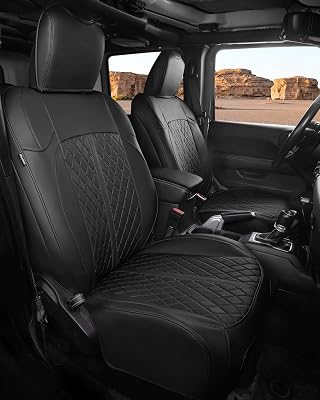
RIDEPOSH Waterproof Faux Leather Full Set — JLU 4-Door 2018–2026
RIDEPOSH bridges leatherette aesthetics with a waterproof backing layer — combining the upscale look of diamond-stitch PU leather with the spill resistance more typically associated with neoprene. The JLU 4-door full set covers front buckets and 60/40 rear bench. The waterproof backing prevents liquids that work under the cover from saturating the OEM foam — a common complaint with standard leatherette covers that lack this layer. Airbag-compatible construction throughout. Best for daily-driver JLUs that see families, kids, pets, and weather without necessarily hitting serious trails where Cordura's abrasion resistance would become essential. Wiping the surface takes seconds. A solid upgrade pick for Sahara and High Altitude owners wanting the leatherette look with added practical protection.
View on Amazon → See current price →JLU Seat Cover Comparison — 2026
| Cover | Material | Coverage | Airbag Safe | Heated Seats | Water Resist. | Price Range |
|---|---|---|---|---|---|---|
| Bartact Tactical BEST | 1000D Cordura | Front pair (rear avail.) | ✓ Non-SRS | ✓ All trims | High (DWR) | $$$ |
| Smittybilt GEN2 | GEN2 Neoprene | Full set (front + rear) | ✓ | ✓ Moderate | High (closed-cell) | $$ |
| Aierxuan Diamond | PU Leatherette | Full set | ✓ | ✓ Good | Moderate | $ |
| GIANT PANDA | Neoprene | Full set | ✓ | ✓ Moderate | High | $ |
| Huidasource | PU Leatherette | Front only + console | ✓ | ✓ Good | Low–Moderate | $ |
| RIDEPOSH | Waterproof PU Leather | Full set | ✓ | ✓ Good | High (waterproof back) | $$ |
Why the JLU 4-Door Needs Different Seat Covers Than the 2-Door JL
The JL and JLU share the same fourth-generation platform — same engine lineup, same front seat frame geometry, and the same integrated side-curtain airbag design in the front seat bolsters. That means front seat covers are interchangeable between the 2-door JL and the 4-door JLU. Any front cover listed for "JL/JLU" fits both configurations correctly.
The rear seat is a completely different story. The 2-door JL has a small, fold-down rear jump seat with a narrow bench width — essentially a bench for occasional passengers. The JLU 4-door has a full-size 60/40 split rear bench: a 40% driver-side section and a 60% passenger-side section, each folding and tumbling independently. This rear bench is substantially wider, requires a cover with a sewn center separator panel to match the split, and must allow both sections to fold and tumble freely after the cover is installed.
Buying a JL-sized rear cover and fitting it to a JLU rear bench will result in too-short coverage, no center separator, and a cover that blocks the fold-and-tumble mechanism on one or both bench sections. Always buy rear covers labeled specifically for the JLU 4-door or "JL/JLU 4-door 60/40 rear bench." Every full-set pick in this guide specifies 4-door JLU rear coverage.
JLU and JKU Generation Guide — All 4-Door Model Years
The 4-door Wrangler Unlimited has spanned three distinct hardware generations since it became a standalone model, each requiring generation-specific seat covers:
JLU Gen 4 — 2018–2026 ★ Current
4-door Unlimited on the all-new JL platform. Front seat covers: JL/JLU-specific. Rear: 60/40 fold-and-tumble bench. Standard 2.0T, 3.6 Pentastar, 3.0 diesel, 4xe hybrid, 392 V8. All trims have front side-curtain SAB.
JKU Gen 3 — 2007–2018
4-door JK Unlimited, predecessor to JLU. Different seat frame geometry — requires JK-specific covers. 2012+ Sahara/Rubicon had optional SAB. Rear bench folds but no factory 60/40 split on base trims.
LJ Gen 2.5 — 2004–2006
TJ Unlimited ("Long JeepLJ") — stretched 2-door with longer wheelbase; NOT a 4-door. Shares TJ seat geometry. No side-curtain SAB. Rear jump seat behind the doors. Use TJ-specific covers.
YJ / TJ — 1987–2006
2-door only. No 4-door JK/JLU equivalent existed. Seat cover patterns are gen-specific and not interchangeable with any JK or JL design. For YJ/TJ, see dedicated guides.
JLU 2018–2026 Trim-Level Fitment Guide
The JLU's eight production trims cover a wide range of seat configurations and factory options. Here's how they affect seat cover selection:
| Trim | Years | Front SAB | Heated Seats | Ventilated | Special Notes |
|---|---|---|---|---|---|
| Sport | 2018–2026 | ✓ All years | ✗ | ✗ | Standard seat profile. All covers fit. |
| Sport S | 2018–2026 | ✓ All years | Optional 2022+ | ✗ | 2022+ heated option — verify before ordering neoprene. |
| Willys | 2020–2026 | ✓ | ✗ | ✗ | Standard Sport seat profile. Rock Rails note: wider door sills. |
| Sahara | 2018–2026 | ✓ | ✓ | ✗ | Heated fronts standard. Fabric/Cordura preferred over neoprene. |
| Rubicon | 2018–2026 | ✓ | ✓ | ✗ | Heated fronts standard. Same seat profile as Sahara — not Mojave geometry. |
| High Altitude | 2021–2026 | ✓ | ✓ | ✓ | Heated AND ventilated fronts. Use Cordura or fabric — not thick neoprene. |
| 4xe (Plug-in Hybrid) | 2021–2026 | ✓ | ✓ | ✗ | Battery floor heat in rear — avoid thick rear neoprene. Cordura or 600D preferred for rear. |
| 392 (6.4L V8) | 2021–2026 | ✓ | ✓ | ✓ | UNIQUE SPORT SEAT — deep bolster, ventilation ports, tall profile. Standard JLU covers will NOT fit. Order Bartact 392 Edition SKU specifically. |
| Mojave | 2021–2026 | ✓ | ✓ | ✗ | UNIQUE SPORT SEAT — Mojave-specific bolster geometry. Standard JLU covers will NOT fit. Order Mojave-specific SKU from Bartact. |
⚠ 392 & Mojave Edition Warning: The 392 V8 and Mojave Edition both use sport seats with a unique deep-bolster, ventilated profile that is dimensionally incompatible with standard JLU seat cover patterns. If you own one of these trims, contact Bartact directly for the correct SKU. Generic Amazon covers will not fit these sport seats correctly.
Materials Guide — Choosing the Right Fabric for Your JLU
Material choice determines durability, maintenance burden, and use-case suitability more than any other factor. Here's how the main options perform in the JLU environment:
1000D Cordura Nylon (Bartact)
Mil-spec 1000-denier Cordura is the most abrasion-resistant seat cover fabric available. It resists tearing when rocks, tools, and trail gear are loaded and unloaded against the seat surface. The DWR (durable water repellent) coating sheds light moisture. UV stability is excellent for open-top use — this material was designed for field deployment, not climate-controlled garages. The only real downside is cost: Bartact covers represent a significant investment. They are worth every dollar if you trail ride regularly.
Neoprene (Closed-Cell Foam + Nylon Face)
Neoprene offers the best water resistance in the seat cover category — the closed-cell structure prevents liquid absorption at the cover surface. Ideal for JLUs used in heavy rain, creek crossings, or by owners who frequently eat and drink in the cabin. It compresses under body weight without losing its shape. Drawback: neoprene holds heat in summer and reduces airflow to ventilated seats. Not the first choice for High Altitude or 392 trim owners whose ventilated seats are a primary comfort feature.
600D Oxford Polyester
Mid-tier fabric that balances durability and price. 600D polyester withstands daily wear well, resists minor spills with quick blotting, and transmits heat from factory heated seats without issue. The correct choice for budget-minded JLU owners or second vehicles. UV resistance is lower than Cordura — fade and stiffening will occur faster on a topless JLU parked in direct sun for extended periods.
PU Leatherette
Synthetic leather offers the best interior aesthetics and the easiest cleanup surface — wipe clean in seconds. Preferred by Sahara and High Altitude owners whose daily use emphasizes cabin quality over trail capability. Heat transmission through leatherette is good; heated-seat compatibility is straightforward. The critical limitation: UV degradation. Standard PU leatherette will crack and peel in 1–2 seasons if the JLU regularly operates with no top in direct sunlight. Waterproof-backed leatherette (RIDEPOSH) adds liquid protection but does not eliminate UV vulnerability. Reserve leatherette for hard-top JLUs or occasional topless use.
Airbag Safety, Heated & Ventilated Seat Compatibility
Every JLU produced from 2018 through 2026 integrates side-curtain airbags into the outer bolster of both front seats across all trims. This is a critical safety distinction from the previous JKU generation, where side-curtain SABs were optional on Sahara and Rubicon from 2012 onward and absent on Sport trims.
Installing a front seat cover without designated airbag break-away seaming on a JLU will physically resist airbag deployment in a side-impact collision. Every front cover on a JLU must be non-SRS certified with break-away seaming. Every pick in this guide meets this requirement for the standard JLU seat profile. Mojave and 392 Edition owners must source covers designed for those specific seat profiles — standard JLU non-SRS certification does not guarantee correct fit on a Mojave or 392 sport seat.
Heated & Ventilated Seat Compatibility
Fabric and polyester covers transmit heat with minimal loss — Sahara, Rubicon, and Willys owners with optional heated seats will feel no meaningful reduction in seat warmth. Neoprene covers transmit heat but at reduced efficiency — expect a slight delay before warmth transfers through the cover. For ventilated seats (High Altitude, 392), neoprene's closed-cell structure partially blocks airflow from seat perforations. Cordura and 600D fabric perform best with ventilated seats, transmitting airflow freely.
4xe Plug-in Hybrid JLU — Rear Seat Note
The JLU 4xe generates battery pack heat that radiates through the rear floor under sustained charge/discharge cycles. Very thick neoprene rear bench covers can trap this heat, raising cabin floor temperature in the rear seating area. Bartact Cordura or 600D polyester rear covers are preferred on the 4xe for unrestricted heat dissipation. Front seat covers on the 4xe have no unique compatibility considerations beyond standard JLU SAB seaming requirements.
Installing Seat Covers on the JLU 60/40 Rear Bench — Fold-and-Tumble Protocol
The JLU rear bench is a full-size 4-door bench with two independently operable sections — the driver-side 40% section and the passenger-side 60% section. Each folds forward (releasing the seatback) and tumbles forward (folding the entire section forward against the front seat). This mechanism must remain fully functional after seat cover installation or you have a safety and usability problem on the trail.
- Remove all items from the rear seat and clear the floor behind the front seats. You need full access to route straps under the bench cushion.
- Install the driver-side (40%) section first. Slide the seatback cover down from the headrest area, feeding the material down over the seatback. Align the cover's inner seam with the section's inner edge — this is where the separator panel sits.
- Route under-cushion straps through the fold-and-tumble frame rail — not over the cushion, not across the seat base. Use the frame rail itself as the anchor point. Excess material stuffed under the cushion will prevent the tumble mechanism from engaging.
- Repeat for the passenger-side (60%) section. The separator panel in the cover should sit naturally in the gap between the two bench sections when both are installed.
- Fold-and-tumble test — mandatory before first use: Fold each bench section forward independently and confirm it lies flat against the front seat base. Then tumble each section completely forward and confirm full range of motion. If either section is impeded by cover material, re-route the straps. Never skip this test.
For front seat installation: slide the cover down from the headrest with the cover inside-out, working the material over the seat shoulder and bolster. Confirm all belt-slot openings align with factory seatbelt hardware before seating the cover fully. Never tuck seatbelt hardware behind the cover.
What JKU (2007–2018) Owners Need to Know
The Jeep JKU was the 4-door Unlimited predecessor to the JLU, sold from 2007 through 2018 as the generation-3 platform. JKU seat geometry is completely distinct from the JLU — front seat frame, bolster dimensions, headrest post spacing, and seatback height all differ between the platforms. JKU owners must buy covers designed specifically for the JKU, not JL/JLU covers.
Key JKU-specific fitment notes: the 2007–2011 JKU Sport had no side-curtain SABs, so the airbag seam requirement applies only to 2012+ Sahara and Rubicon trims where SABs became optional. The JKU rear bench has a fold-flat mechanism rather than fold-and-tumble, so rear installation is simpler but cover compatibility with the JL/JLU rear bench cover format does not apply. Bartact makes dedicated JKU seat cover patterns that account for all these differences — do not cross-shop JLU and JKU listings as equivalent.
If you're upgrading from a JKU to a 2018+ JLU and planning to transfer seat covers: they will not fit. The platforms are not compatible. Budget for new covers when you take delivery of the JLU.
Frequently Asked Questions — JLU Seat Covers
What are the best Jeep Wrangler JLU seat covers in 2026?
The best JLU seat covers are Bartact Tactical Covers — mil-spec 1000D Cordura nylon, non-SRS airbag certified, with genuine MOLLE/PALS seatback webbing and 4-door JLU-specific construction, made in the USA. For best waterproof full-set coverage, Smittybilt GEN2 Neoprene covers both front and the 60/40 rear bench. For best interior aesthetics, Aierxuan Diamond Stitch leatherette upgrades the cabin look with a custom-cut fit. Each pick above is verified for JLU 2018–2026 fitment.
What is the difference between JL and JLU seat covers?
Front covers are interchangeable — both JL and JLU share the same front seat frame on the gen-4 platform. Rear covers are not interchangeable: the JLU has a full-size 60/40 split fold-and-tumble rear bench requiring a specific 4-door rear cover with center separator panel. The JL has a narrower, simpler rear jump seat. Always confirm rear-cover listings specify 4-door JLU or 60/40 rear bench fitment.
Do all JLU trims require airbag-compatible seat covers?
Yes — every JLU (2018–2026) on every trim from Sport to 392 has integrated side-curtain airbags in the outer front seat bolster. Front covers without non-SRS break-away seaming will resist airbag deployment in a crash. Every pick in this guide is non-SRS certified for the standard JLU front seat. The 392 and Mojave Edition require SKUs specific to their sport seat profiles — standard non-SRS certification does not guarantee correct fit on those seat geometries.
Will JLU seat covers fit a Jeep JKU (2007–2018)?
No. JKU and JLU seat geometry differs significantly — front frame dimensions, bolster shape, headrest post spacing, and seatback height are all JK-platform specific. Buy covers designed for the JKU (2007–2018) rather than trying to adapt JLU covers. Bartact makes dedicated JKU patterns. For the rear, some universal bench covers span both platforms, but custom-fit rear covers require the correct generation.
What is the best JLU seat cover material for trail use?
Mil-spec 1000D Cordura (Bartact) is the best material for trail use — highest abrasion resistance, UV stability for open-top operation, DWR moisture resistance, and genuine MOLLE seatback webbing for trail gear. For water and mud exposure, neoprene (Smittybilt GEN2 or GIANT PANDA) is the best waterproof option. Leatherette is best for road use and aesthetics but should be avoided on topless trail-use JLUs.
How do I install rear bench covers on a JLU 60/40 split bench?
Install each bench section independently. Slide each seatback cover down from the headrest, seat the cushion cover, route straps through the fold-and-tumble frame rail under the bench (not over the cushion), and test both sections fold and tumble completely before first use. The center separator panel in the cover aligns with the gap between the 40% and 60% bench sections. Do not stuff material under the cushion — it blocks the fold mechanism.
Do the 392 V8 and Mojave Edition JLU trims fit standard seat covers?
No. Both the 392 and Mojave Edition use unique sport seats with a deeper side bolster profile, ventilation ports, and a taller seat height than standard JLU seats. Standard JLU covers will not seat correctly on these trim-specific seats. Contact Bartact for the dedicated 392 Edition or Mojave Edition SKU. Generic Amazon covers are designed for the standard JLU seat profile and will not accommodate the 392 or Mojave sport seat geometry.
Are JLU seat covers safe for the 4xe plug-in hybrid rear bench?
Yes, with one consideration: the 4xe battery pack generates heat through the rear floor under charge/discharge cycles. Very thick neoprene rear bench covers can trap this heat. Bartact Cordura or 600D fabric rear covers allow heat to dissipate freely and are preferred on the 4xe. Front seat covers on the 4xe have no unique compatibility requirements beyond standard JLU SAB seaming.